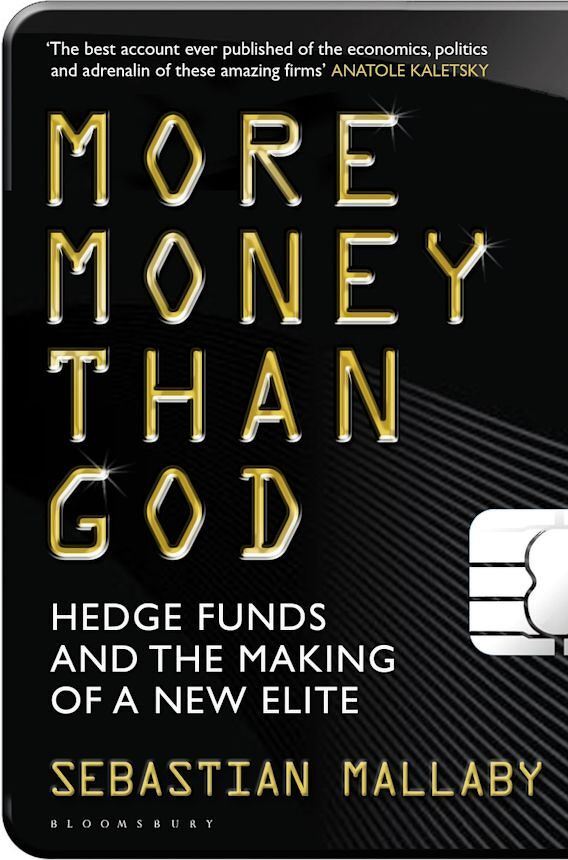
'More Money Than God' provides a comprehensive history of the hedge fund
📚 Finished listening to More Money Than God by Sebastian Mallaby.
This feels like a veritable encyclopedia of the history and evolution of hedge funds or, as they were originally called, back when they were invented in the middle of the 20th century, hedged funds. It’s not overly dry though; much of it is the stories of the ups and downs of various people heading these at-one-point-innovative funds.
What is a hedge fund? Well, roughly it is a private investment fund that…hedges. The idea being that unlike, say, more conventional stock funds that tend to pick stocks and hope they go up, they’re free to employ innumerable different investment strategies in all directions with the idea that no matter what happens you will have a lower risk of making a catastrophic loss whilst still capturing much of any gains in the market.
A basic example, although this is from my head rather than the book, so caveat emptor. Imagine you are convinced that a specific airline company stock is undervalued and hence going to skyrocket soon. You buy it. Then some disaster happens (e.g. a pandemic, to pick a non-random example) and every part of the airline industry shoots down in value. Sure, maybe your chosen stock was a good buy in other circumstances. But these are not those circumstances, so you lose a ton of your money, unlucky.
How could you hedge? Well, perhaps you identified another airline stock that you think might be overvalued, or even just fairly valued. Or perhaps you feel like placing a bet on a basket of all airline stocks out there. Either way, you short this stock - meaning in effect betting that it will go down. Then, if there is no pandemic then you might or might not lose money on the short but you’ll win big if you were right about the original airline stock you favoured. If there is a pandemic that temporarily destroys the whole industry then you’ll lose on your original stock pick but given you bet against another part of the same industry you will mitigate your losses with the profits you make from that trade.
Some also try to use a combination of psychology, math and economic strategies to take advantage of predictable inefficiencies in the market that are complicated enough to be unavailable to your average stock picker (and perhaps unbelievable to someone schooled in the strangely mainstream ideas of capitalism and its super efficient invisible hand, which, to my reading, is not quite what Adam Smith really had in mind, at least not in the uber-libertarian sense)
These funds tend to have certain characteristics that make them different to the average fund a retail investor might have gotten into. They’re generally accessible to only people who are provably wealthy or sophisticated investors. A random member of the public isn’t going to get direct access to them. They often require a minimum investment that will seem massive to the average retail investor. They’re generally considered risky (although this book provides some arguments in the other direction). The fees are relatively huge - typically 2% of the value of your investment plus 20% of any returns. You may be limited in how much and when you can withdraw your investment. And the fund managers tend to have their own wealth tied up into them.
Nonetheless, their freedom and flexibility has allowed some investors to make vast sums of money (and others, not so much) despite their original concept surrounding the idea of reducing market risk rather than chasing the highest returns. After all if you were right about your favoured airline stock then the hedge will reduce your profits. It’s a kind of insurance, and we all pay for insurance.
Since the 1950s they’ve become a large part in our financial system. You might be familiar with the names of some of the pioneers or managers - A. W. Jones and George Soros being perhaps the most known.
Whilst the book details some abject failures and ethical concerns with specific funds - not least how some played a substantial role in the partial destruction of various vulnerable economies and the ensuing misery that would cause the relevant country’s population - the author comes across as having a general favourable opinion of the idea. Even in its arguably distorted modern incarnations. Not least because these funds are rarely “too big to fail”. Unlike conventional banks, they didn’t need (or at least get) a tax-payer funded bailout in the 2008-era financial crisis. However, they, like most of the financial investment system, remain in my mind a totally unnecessary invention that in a perfect world probably shouldn’t exist. However, I was pleased to learn all about them from a seemingly very comprehensive history of the industry.