Britain's dependence on US technology makes us vulnerable
Last week the FT had an article that I’d particularly recommend anyone who is unfamiliar with such awkwardly-named concepts such as “digital sovereignty” to read.
In a world where our ability to operate effectively is governed in so many ways by the nature of our existence in the digital realm, and where, once again, so many of the online services involved are in fact the exclusive fiefdoms of some weird uber-rich American billionaires who increasingly appear to act under the cringe-worthy control of the more vindicative Trumpist arms of their government - what would it look like for us here in the UK to live a “Life without US tech”?
The experience of ICC judge Nicolas Guillou after Trump decided to impose sanctions upon him simply because he didn’t like some of his rulings provides a clue.
Within days, he was cut off from all the services that rely on US companies. He could not have an American credit card and instead had to rely on cash and national payment systems such as iDEAL in the Netherlands for online transactions.
Wire transfers bounced back. His hotel reservations on Booking.com and Expedia were cancelled. He could not rent a bike from the City of Paris’s public Vélib’ Métropole scheme, which requires a credit card guarantee. Packages delivered by UPS were returned to the sender. His health insurer tried to cut him off.
This is distinct from the occasion where the ICC’s chief prosecutor, Karim Khan, reportedly had access to his Microsoft email account cut off overnight for similarly petulant reasons.
For those of us who are not ICC judges, whilst Trump et al may not have any particular unhinged reason to pick on us personally, it’s not like it’s impossible that our whole country could come under some kind of foreign-government-mandated exclusionary policy in retaliation for some real-or-imagined perceived national slight that one of our citzens made against the big-baby-snowflake president or whatever.
Trump has already threatened to (continue to?) wage a damaging economic war on us if we don’t change our tax laws to suit his preferences. And elsewhere, well, as Jordana Timerman writes: “Reward countries that toe the line, punish those that don’t: that’s how Trump is exerting control in Latin America”.
And that’s all before we discuss all the myriad of other, far more prevalent, ways these services can further turn against our interests well short of an absolute ban, independent of their country’s presidential preferences.
The FT’s “day in a life” flow chart shows how something like that could render us unable to access our email, payment systems, cash, messaging apps, documents, social media, AI tools, online shopping, delivery services, maps or streaming services.
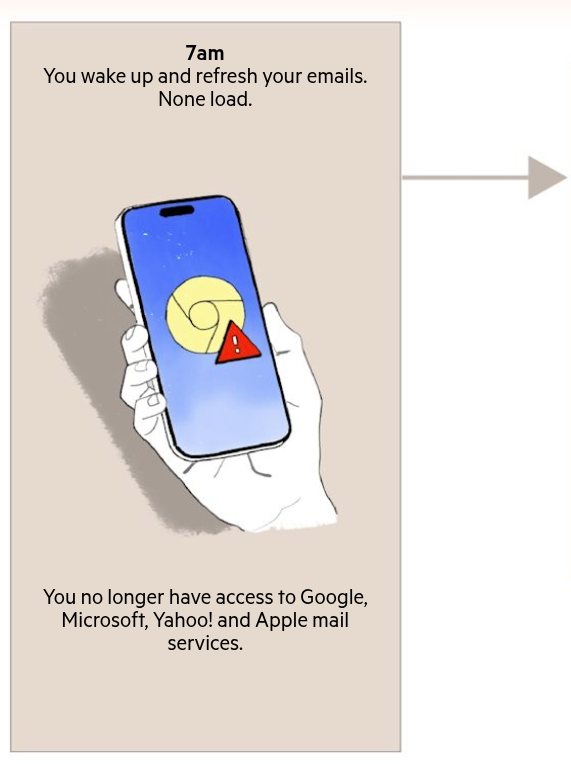
And that in some cases there really aren’t all that many great alternatives we could switch to should the US (or these companies) decide we are not to be served. Or at least not great ones that the average person-in-the-street knows about. The article goes a bit deeper into some of the efforts of Europe in general to extract itself from this obvious trap. I hope they - I hope we - succeed.
Whilst the real solutions to almost all of today’s massive societal threats are of course actually to be found at the societal level, in the mean time I think this is actually one of those problems we can also usefully take the time to think about ourselves at a personal level. There’s a lot we can do to make ourselves and our loved ones less personally vulnerable to this particular strain of threat.