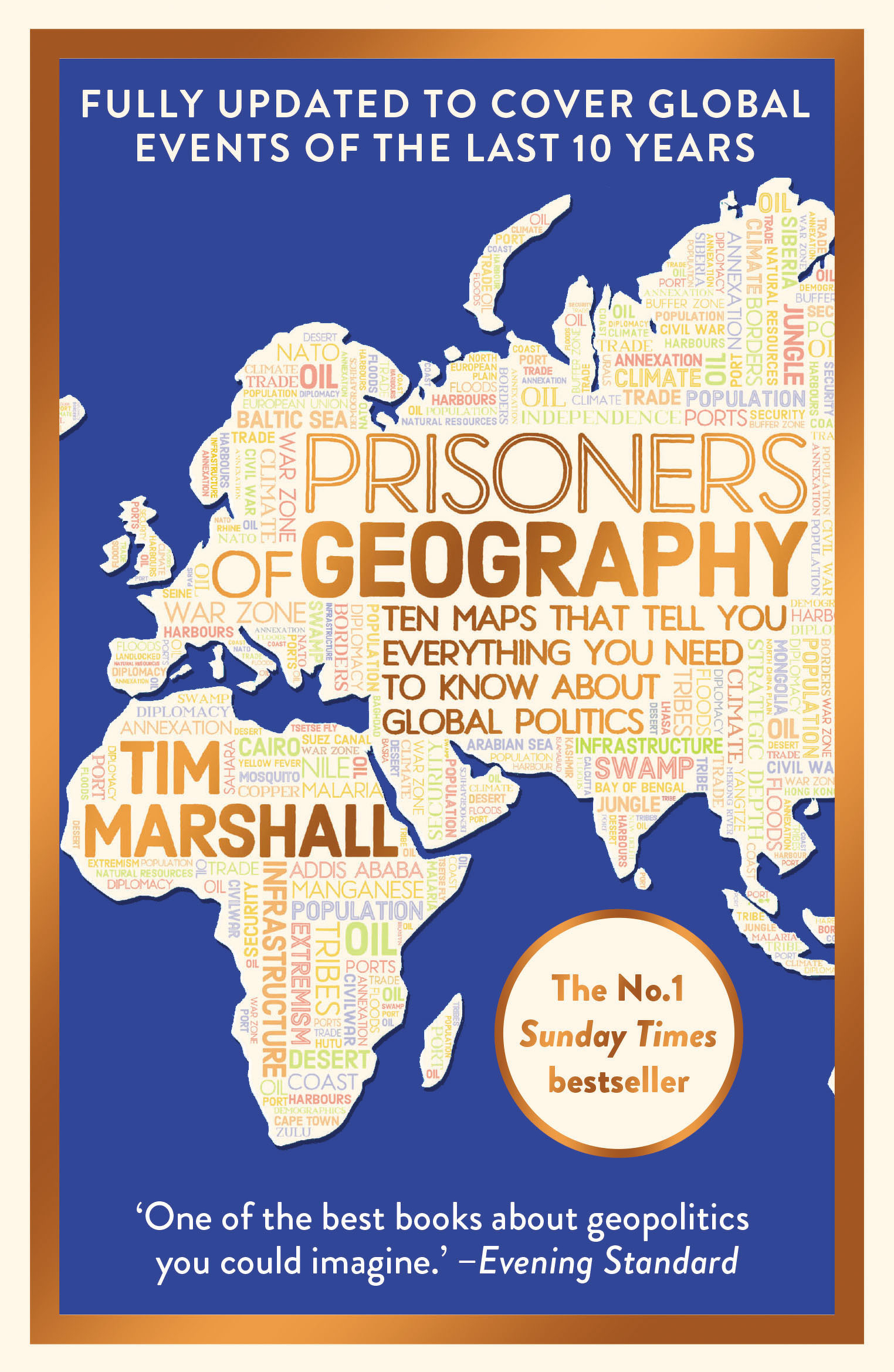
Tim Marshall's 'Prisoners of Geography' may help you understand the world at least a little better
📚 Finished reading Prisoners of Geography by Tim Marshall.
In my quest to try and understand something about how the chaotic-seeming modern world works, geopolitics edition, I’ve had this one on my list for a while, but delayed it until now when I heard a 10th anniversary edition was coming out that’s been updated for the massive and often bizarre and horrific seeming twists and turns that have happened in the world since the first edition of the book was written. This lets it talk about, for instance, the contemporary Russian invasion of Ukraine.
However it did come out before the US initiated its war-of-choice against Iran. Nonetheless, it contains some rather prescient words that, yet again, put a lie to the Trump administration’s claim that no-one anticipated Iran closing the Strait of Hormuz when the US invaded:
The threat of an Israeli air strike on Iran’s nuclear facilities is a constant presence, but there are restraining factors. In a straight line it is 1,000 miles to Iran, meaning the IDF would have to fly over Jordan and Iraq; the latter would certainly warn Iran that the attack was coming. Refuelling of planes would be challenging, but the 2024 air strikes on Iran suggest that Israel can do it, and its destruction of Syria’s air defences in the same year has potentially opened an alternative route.
However, Iran has a deterrent – the ability to close the Strait of Hormuz in the Gulf through which passes roughly 20 per cent of the world’s oil needs. At its narrowest the strait is only 21 miles across. The industrialised world fears the effects of Hormuz being closed, possibly for months. Nevertheless, an Iranian bomb is an existential issue for the Israelis.
Anyway, the main premise of the book is that the history, development and contemporary actions and abilities of any given country is shaped, even in today’s technologically advanced world, by its geography; especially its physical features such as mountains, rivers, seas, climate and so on. In fact these even shape the borders of countries; many of the man-made lines one sees on the maps of today run down waterways or butt up against mountains for example. And places where they don’t - for example some of the context-free straight lines that, for instance, various colonial or wannabe-colonial external powers drew over Africa or the Middle East as they relinquished their unjust control or following other global events - are often troubled in many ways.
States with physically defensive borders, plenty of natural resources, useful coastlines and navigable waterways (useful for transport and trade) have natural advantages. Those that don’t, don’t. Those surrounded by easy-to-invade flat plains, that are deserts or have few water-based transport options find it more of a struggle to develop.
A couple of examples:
- The North European Plain and consequent absence of physical defences to Russia’s west leave it exposed to invasion which to some extent explains its historical desire to acquire buffer zones. Despite its size, it also has very little access to the sort of sea ports that support an extensive navy or trading links - because most of those it does have regularly freeze over, and many would also involve routes through chokepoints vulnerable to the actions of other countries - which is also an incentive for conquering territory that provides access to warm water ports. The author does point out that it’s not the case that this is the only driver of Putin’s violent and illegal actions.
- Why has there not been more military trouble between India and China than there has been (which to be fair, is not a negligible amount)? The assertion here is that the Himalayas that divide them make an invasion hard to pull off.
The book covers a lot more than the simple geographical features of a place - history, culture and politics are part of the whole story, not least because they too can be derived to some extent from the geography according to the author’s premise.
It’s all extremely engaging. The author has written others in the series that are now on my list. I’m sure it’ll have faced some criticism that it’s a bit over-simplified and deterministic, and maybe it is - but I don’t think it’s fair to suggest that it suggests that everything about a country is geographical feature related. There is mention of modern technology overcoming some historical limitations - but just that it’s not yet at the stage of overcoming them all to the extent that the natural surroundings of a country are irrelevant. Far from it. I mean, we can look at what’s going on with the Strait of Hormuz now once again for an all too obvious example.
There were likely similar criticisms of a (slightly drier, as I remember, but still very instructive) book I read ages ago, Guns, Germs, and Steel which situates the major waxing and waning of the world at the civilisational level in terms of the differences in local environment they existed within, a fairly similar theme.

The chapters are arranged one per region of the world it concerns itself with, i.e. the sub-titular 10 maps. These are:
- Russia
- China
- The USA
- Latin America
- The Middle East
- Africa
- India and Pakistan
- Europe
- Japan and Korea
- Greenland and the Arctic
The book does contain maps of each, rather essential to those of us with my sadly lower level of geographical knowledge. They’re very useful but to be honest I think I’d have done even better to get hold of separate maps to look at as I read through the pages rather than having to flick back constantly to the relevant map. There’s a free idea for an add-on for the author! But if you already own an atlas, find it before you begin this very worthy guide to a surprising number of aspects of the world and its development.