The inventor of the world wide web implores us to remember that 'This Is For Everyone'
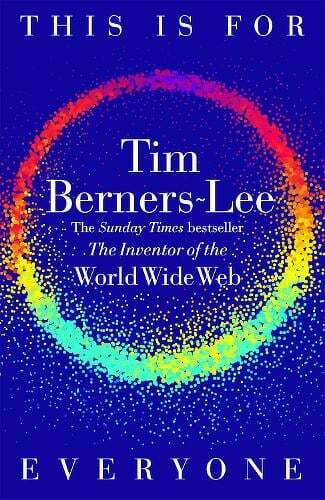
📚 Finished reading This Is for Everyone by Tim Berners-Lee.
This is partly a biography of possibly the only both famous and decent “guy in tech” that I’m aware of - Tim Berners-Lee, the inventor of the world wide web. And, secondly, a manifesto for his original vision for the web and what we need to do to save it from the actions of the extremely indecent “guys in tech” that are doing their level best to destroy the very intent of the web.
Berners-Lee basically invented the web as a somewhat random project whilst working at CERN. No-one seemed greatly interested at first, but, as we all know by the very existence of this website, people eventually became extremely interested.
He was, and is, a very idealistic gentleman and insisted on giving the technology away freely. No patents, no commercialisation, no restrictions on at least the underlying protocol.
Fundamentally, amongst other huge differences strictly in favour of the web, Facebook can ban me from participating in their ecosystem. No-one can ban me from participating on the web. Facebook of course greatly leverages the web itself, without paying Berners-Lee a cent.
By layering (relatively) easy-to-write hypertext pages on the already existent-internet his dream was to unleash a new era of creativity and collaboration. Information wants to be free! You don’t need a degree in computer science to make a webpage. You don’t need a PhD to read one.
His dream came true. Well, at least for a while, and where it’s latterly failed at all it sure wasn’t his fault.
What went wrong? Well, it could be summarised as corporate capture by the surveillance capitalists. Contrary to the originating vision of huge numbers of equal peers communicating and collaborating across this license-free protocol, a few huge companies - Google, Meta, Amazon et al - have grown to almost entirely dominate the space.
Each of these maleficent players exploits their users' data for their own financial gain, each locks away valuable information in pay-only vaults, each designs their products to explicitly track you, advertise to you, exploit and manipulate you. Facebook of course provides the arch-example of this. But they’re all at it, all optimising for some form of “engagement” for private profit over any consideration of well-being. Algorithmic social media keeps important information in private silos, incentivises clickbait, deliberately enrages its users, spreads disinformation, surveils you to extract and sell your personal data and so on all because this makes you stay within their private walls longer, to hand over more information, to spend time, money and attention contrary to our own interests - all of which are more profitable for them. This could not be further from Berners-Lee’s vision of a hypertext paradise-for-all. And he’s here to explain the problem, and hopefully help us sort it out.
Especially as the era of AI has already clearly dawned. He is perhaps less doomy than some other folk as to the likely impact of AI on the web, but fully understands that there is a necessary fight to be had if we are to be left with any semblance of his vision, let alone much chance of AI improving the lives of the everyday person rather than just the lives of a few weird tech billionaires. The author understands that technology is not self-determinate; rather the social conditions under which it emerges and evolves govern whether it will be used for good or ill.
His favoured solution to the mess seems to address primarily the topic of data sovereignty and interoperability. You should own your data. You should control your data. It should be easy for you to share the bits of it you want to share with specific organisations.
To this end he has helped create a new free-to-everyone protocol called Solid. I had only very vaguely heard of it before, and I’m still not sure if it’s all that likely to solve every one of the web’s current woes, but I’m certainly going to dig a bit deeper into it given its esteemed provenance. You can certainly see the influence of his original vision for the web in how the Open Data Institute, an organisation he co-founded, talks about it:
It’s a bit like carrying all your data in a rucksack with lots of pockets. To access the data, different apps can only open the pocket you allow them to open, rather than taking the whole rucksack. The rest stays private.
Solid lets people take control of their data and combine it to achieve new results. It gives creators new collaborative tools while passing power back to users. It’s technology that returns the web to its original vision of serving people.
Read the book, join the fight!
Although I have to say, if I’d chanced upon his present company’s website - Inrupt - out of context I wouldn’t give it much of a glance. Phrases like “Agentic Wallets add AI for innovative, compliant, and hyper-personal experiences” rather set off tech-bro alarms in my head. But Berners-Lee’s original vision for the web was so beautiful - and if this book is to be believed remains his primary motivation - and his invention and gift to humanity so great, that I feel like it would be wrong not to give it every chance.