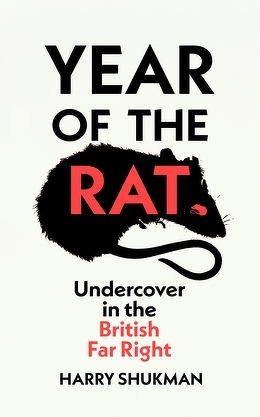
Harry Shukman goes undercover to discover what is really going on behidn the scenes of the British far right movement in his 'Year of the Rat'
📚 Finished reading: Year of the Rat by Harry Shukman.
This is Harry Shukman’s self-authored book about his time as an undercover journalist trying to infiltrate himself into various groups associated with the ghastly British far-right political movement in order to learn and expose what really goes on behind closed doors. Who is involved, and why? What do they do? How do they work? What do they say behind closed doors, to one of “their own”? How do they interact with each other? Who is pulling the strings? How are they funded?
You might have already seen parts of his story as blog posts from his employer, Hope Not Hate, or as part of a reasonably famous Channel 4 documentary - “Undercover: Exposing the Far Right”. This book is a provides far more detail on those operations as well as a further swathe of experiences from his time encountering and attempted to be accepted as a play in the various other unsavoury groups and individuals that he encountered along the way. It felt like one lesson here is that movement is more networked than it might seem. He found himself able to use his membership of one particular group to ingratiate himself into being invited to join another.
Reading what does actually go on in these groups, how they think and so on is of course, very unpleasant reading. Whether it will shock you in a world where each day the news appears to be full of the sort of racism, hatred and prejudice that a younger, more hopeful version of myself might have hoped had been crushed down to a handful of insignificant madmen - the vast majority of people featured are indeed men - who form the last impotent remnants of the horrendous rise of the 1970s National Front, I don’t know.
But we all live in different filter bubbles. And if you have any doubt that the very worst kind of prejudices from people, some of whom have violent fantasies based on delusional levels of hatred, are still out there in a way that still very much matters to the future of Britain and its population then this book might set you straight.
It seemed to me like there are two distinct sides of the movement, albeit with some connective tissue, both of which are necessary to understand.
There’s the version that some folk like to portray as just being “the average man in the street” who has “reasonable concerns” about his brown neighbours; the unstructured grassroots movement of self-selected citizens with a (twisted kind of) conscience. You and me. If we hated “foreigners”.
There’s potentially some truth to that idea. Shukman starts off by joining the Basketweavers, at a gathering of ostensibly fairly “normal” men who have no discernible interest in weaving baskets but are instead happen to be very paranoid, and have horrendous opinions. And are lonely. So lonely.
But unfortunately the salve they sought for their loneliness led them down the YouTube influencer wormhole or equivalent until they too feared the Great Replacement conspiracy, loved eugenics, hated (and believed in the existence of) “low iq races” and disbelieved the Holocaust. They actually believed that some traumatised asylum seeker was in fact only here to destroy England from their state-provided 5* hotel experience.
A grievance against women and tinges of incel culture were also common in this milieu. There seemed to be quite some overlap with the “manosphere”. Shukman encounters dating advice here and there, mostly culled from the pick-up-artist scene.
You can’t help but feel the “men would do anything except go to therapy” meme fully applies here. This is in no way to excuse their vile views or actions. They do terrible harm. They must be stopped, convinced to see that reality is not what they think it is. But there’s a sense of desperation in many of this group, and that if only they’d found a five-a-side social football club or clicked on a different Facebook post they might not be furtively meeting up in a pub in order to egg each other on to the say N word out loud - and everyone’s life would be better.
Then there’s the side that us normies, and possibly most of the folk in the above groups, are not supposed to know anything about - the radical right elites.
Here we’re talking about rich business men, race-science obsessed “scientists”, politicians and their acolytes, investors, and, inevitably, the occasional Silicon Valley tech bro. These people fancy themselves as the intellectual elite of the movement, “saving” British society from whatever conspiracy addled delusion they at least claim to believe whilst, in many cases, uncoincidentally vastly enriching themselves with money, power and status. Often by manipulating the pub-going people from the previous paragraph into doing their bidding.
We all know that the likes of Tommy Robinson, for all their working-class pretensions, are extremely wealthy. How? A mix of exploiting their followers - endless requests for donation - and secretive wealthy investors would seem to be the order of the day for these folk. In fact pretending to be an investor with money to burn was one way that the author successfully managed to get into some of this scene.
If ever one thought the modern-day British far right scene emanated from a miscellanea of average folk with concerns coming together to fly a flag, well, no. That’s what we are often told we are seeing. But behind the scenes it’s a lot more organised than that. And it has much worse intentions.
The elite are the people who, in a direct facsimile of their generally unfounded conspiracy theories, themselves infiltrate our everyday institutions, deliberately concealing their true views in a conscious strategy to leverage their privilege and access in the name of rapidly shifting the Overton window further in the direction of their despicable ideology. Recent news-watchers cannot not fail to have noticed that British mainstream political parties are openly and enthusiastically discussing ideas that would have been totally unacceptable not all that long ago.
What we actually do about all this is less obvious. The book is very readable, and I would recommend we all do so. A handful of parts are even deadpan amusing, in amongst the general horror. It is very important for us all, no matter what our political leanings are, to know what is really going on out there - how the structure of the British far right works to promote the interests of a few appalling and avaricious ideologues who manipulate groups of desperate lonely men in order to promote their own sick interests.
But the first step to solving a problem is to understand what it is and we should be entirely grateful to the author for potentially putting his life in jeopardy in order to reveal the truth behind the movement’s headlines. I already valued and supported Hope Not Hate who often do this kind of critical research amongst other action against the far right, and this has only convinced me further, and I hope you will consider doing so too.
I’m just not certain at present what the best next step is.