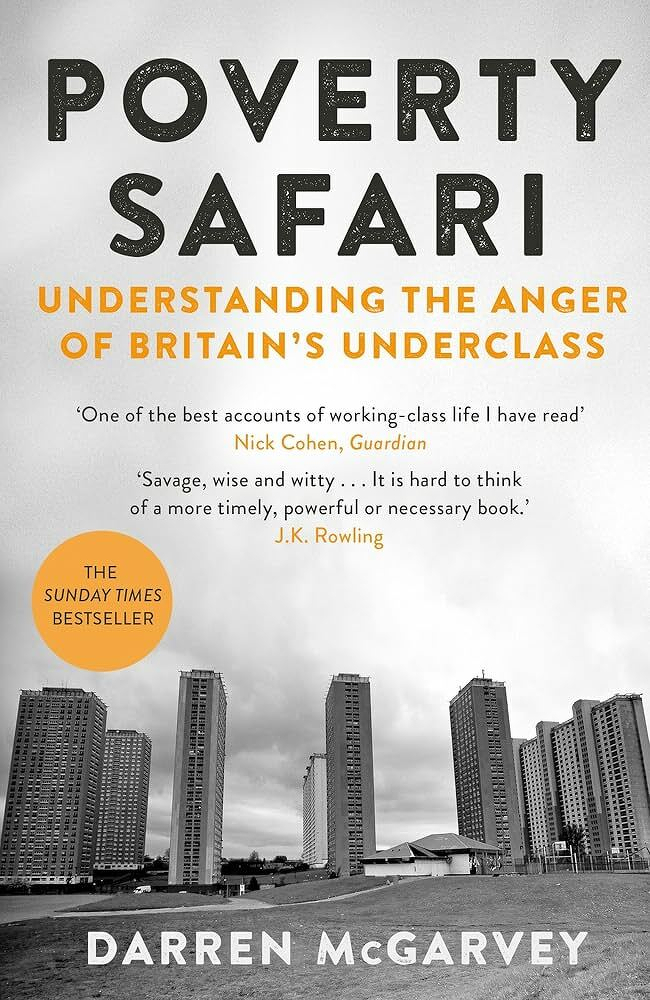
Poverty Safari provides insights into the lived experience of poverty and what should be done to alleviate this social ill
📚Finished reading Poverty Safari by Darren McGarvey.
This book is a mixture of the author’s autobiography and his beliefs and policy prescriptions of how we could and should improve the lives of some of the most economically-deprived struggling Britons out there.
He himself grew up in a deprived area of Scotland, and certainly had a very tough early- life experience. This included bouts of violence, addiction, homelessness, the death of his mother and various other huge challenges, the impact of all of which were exacerbated by the lack of resources available to him and his community after years of austerity and social change hollowing out traditional community resources, amongst others.
His lived experience thus gives him, and hence his readers, some deep insights as to what a life of poverty is really like and what should be done to tackle this perfectly preventable social ill that blights the lives of so many of us today.
By his telling, poverty should be thought of as being far wider in scope than simply financial deprivation. The struggles of such a life also produce social exclusion, emotional distress - including anger, shame, resentment - and a kind of psychological trauma that those of us who do not experience these hardships may not intuitively understand. There is a strong association with what today we call adverse childhood experiences, which commonly will play out in negative ways in later life.
It’s largely taken as read that the right wing tradition has no understanding of and probably very little interest in fixing this issue. In fact the Thatcherite revolution et al was likely a primary cause of the cruelty that resulted in the status quo. But whilst he comes from a background of left-wing politics, he - unlike what you might predict from the earlier autobiographical sections of the book - does often harshly criticise the modern left’s admittedly well-meaning approach .
He critiques most of the institutions that are set up ostensibly to help with such matters as being totally out of touch with the reality of the real life experience of poverty. They don’t talk to the people who are subject to it, they don’t listen to what they have to say. Hence they, at best, design and promote policy “solutions” that are useless or worse.
He sees such institutions and their leaders as frequently focusing on big vision overthrowing-the-system type thinking. Nice in theory, sure, academically fascinating perhaps. but, in his view, unrealistic and hence unhelpful. Instead, he would prefer them to promote and implement practical solutions that will actually benefit folk in poverty concretely today - resources such as community centres, mental health support and education. Instead, the blue-sky thinking apparent in many such institutions mainly create everlasting jobs for the typically middle class employees who work on these problems (and who might be put out of a job should the problem they’re addressing actually be solved) - but do little to meet their stated aim of improving the lot of poorer people.
This is not to say he doesn’t believe in some of the possibly more academia-associated ideas such as structural concepts of injustice. But rather, whilst tackling them, insists that we must not overlook any alleviating solutions that we know will work today, right now - lessening the unjust suffering of poorer communities immediately rather than in some supposed decades-hence utopia.
He also has some criticism some of those folk who suffer poverty which I have to say did not sit so instinctually comfortably with me - perhaps then I am part of the problem in his view. He instructs them to not wait for solutions from above but rather inculcate a sense of personal responsibility, of realising that they have agency in their lives, of not making excuses that result in the blame for an unhappy life being situated entirely in a bad government rather than their own life choices, of not failing to take advantage to the non-zero modes of assistance that are actually available to them. It is incumbent on the governing classes to listen to those voices of those who struggle - but also incumbent on those excluded from society by poverty to make their voices heard.
This all feels like good, sensible, sometimes research-backed advice, but it is of course always a fine line between “personal responsibility” type lines and victim blaming. Nonetheless, I can certainly believe that if we do not actually believe we can do something to improve our lives then it is much less likely that our lives will in fact be improved. And there are certainly links between feelings of agency and mental health conditions such as depression.
He also calls to us all to subject ourselves to some rigorous intellectual introspection and honesty. Think about your beliefs on this subject (and others). Why do you believe what you believe? Why do you think a specific solution to poverty is the right one? Do, by any chance, you happen to believe the same things as your parents and your peer group do? What would it take to change your mind?
Sure, what you intuitively think might be right - but it is rather unlikely you were born with a perfect grasp of reality and the solutions to social ills in your brain. He uses his own journey, which started off from a place of futile resignation, anger, self-destructive tendencies and a deep resentment and prejudice against anyone he believed was not “working-class” into a far more nuanced and, let’s hope, helpful to him and to society in general mindset - part of which has been channelled into writing this book.