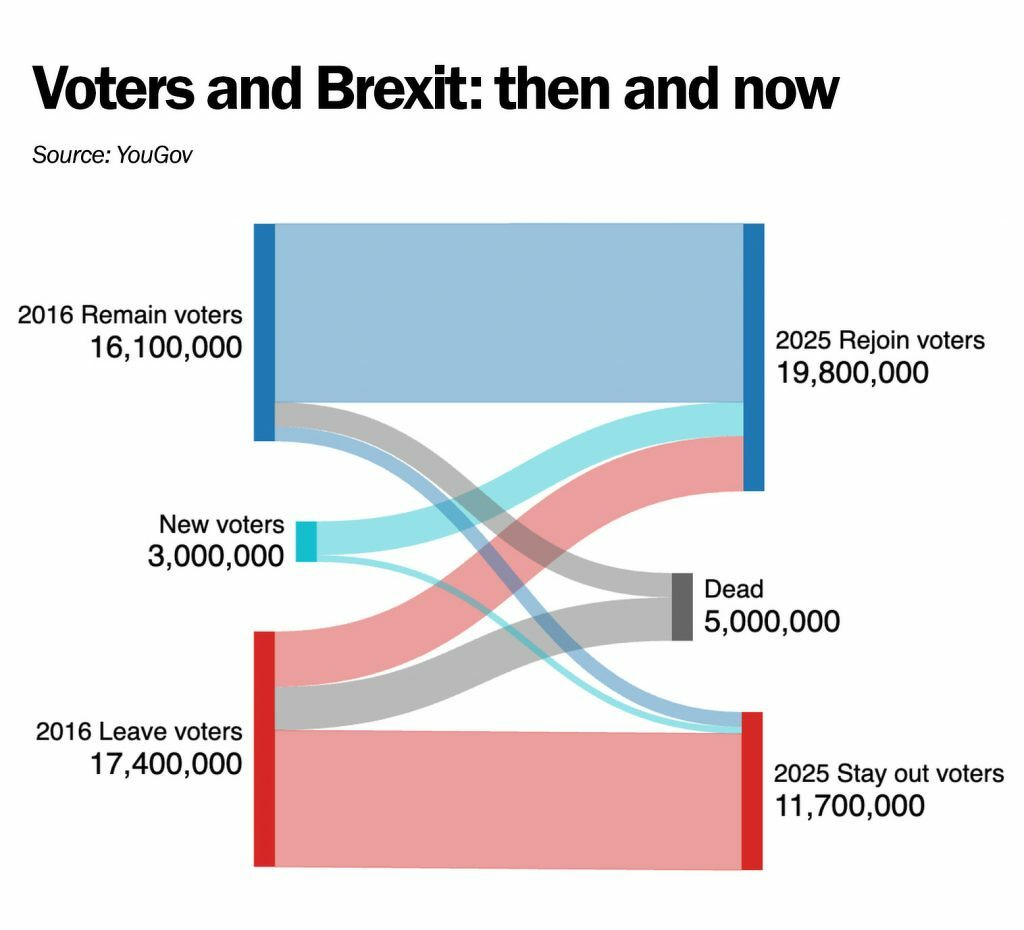
Demographic and attitude shifts suggest that if the Brexit referendum was held today, the pro-Remain side might win by around 8 million.
Peter Kellner uses Yougov data to estimate how many British people might vote or against Brexit if the referendum happened again today. He comes out with a figure suggesting a rather anti-Brexit verdict today:
…the combined impact of demographics and changed minds is to convert a 1.3 million majority for leaving the EU into an 8.1 million majority for rejoining it.
Something like this can only be a rough estimate that is riddled with assumptions. But, if nothing else, it reminds us that, as with every election, whatever the result was in the past, it might not remain the same in the future. Things change. People change. Priorities change. That is after all why we have governmental elections every few years!
There are several dynamics at play here.
Firstly, older people were more likely to vote at all, and more likely to vote for Brexit. They are also, sadly, more likely to have died since the original referendum in 2016.
Secondly, some people who were too young to vote in 2016 are now old enough to vote. And the youngest cohort of voters poll as very pro rejoining the EU.
As Kellner, somewhat harshly, puts it:
We are told that it would be undemocratic to overturn the 2016 referendum result. After almost ten years, that requires a belief that the votes of the dead count for more than the views of the young.
Thirdly, some people who did vote in the previous referendum and are still alive to vote today have changed their minds. Changed their minds in either direction of course, but Yougov polling suggests that shifting from pro-Brexit to anti-Brexit is rather more prevalent than the reverse; probably no surprise after the general catastrophe it turned out to be.
8% of those who voted Remain would now vote to stay out, while 29% of Leave voters want to rejoin.
All in all, the estimates of the volumes involved in this dynamics can be visualised, as he does for his New World article, like this: